Sunday, 3 July 2022

Fording the river Esk, like the Romans

My wife's great Aunt's family lived in a small house on the sand dunes at Eskmeals in Cumberland. As with Tyneham in Dorset, or Imber on Salisbury plain, the MoD came along at the beginning of the 20th Century and requisitioned the land. At Eskmeals, they were moved a short way away, and the 1920s replacement is still in the family, used over generations as a holiday home. The nature reserve is often closed to visit during the working week.  

Walking down to the nearby estuary, wading in the shallows, and watching people getting stuck whilst squeezing cars under the railway viaduct at high tide has long been a family pastime. Indeed, as we arrived for our week here, there was an Audi with bonnet up, still sat there three hours later, awaiting repair.   
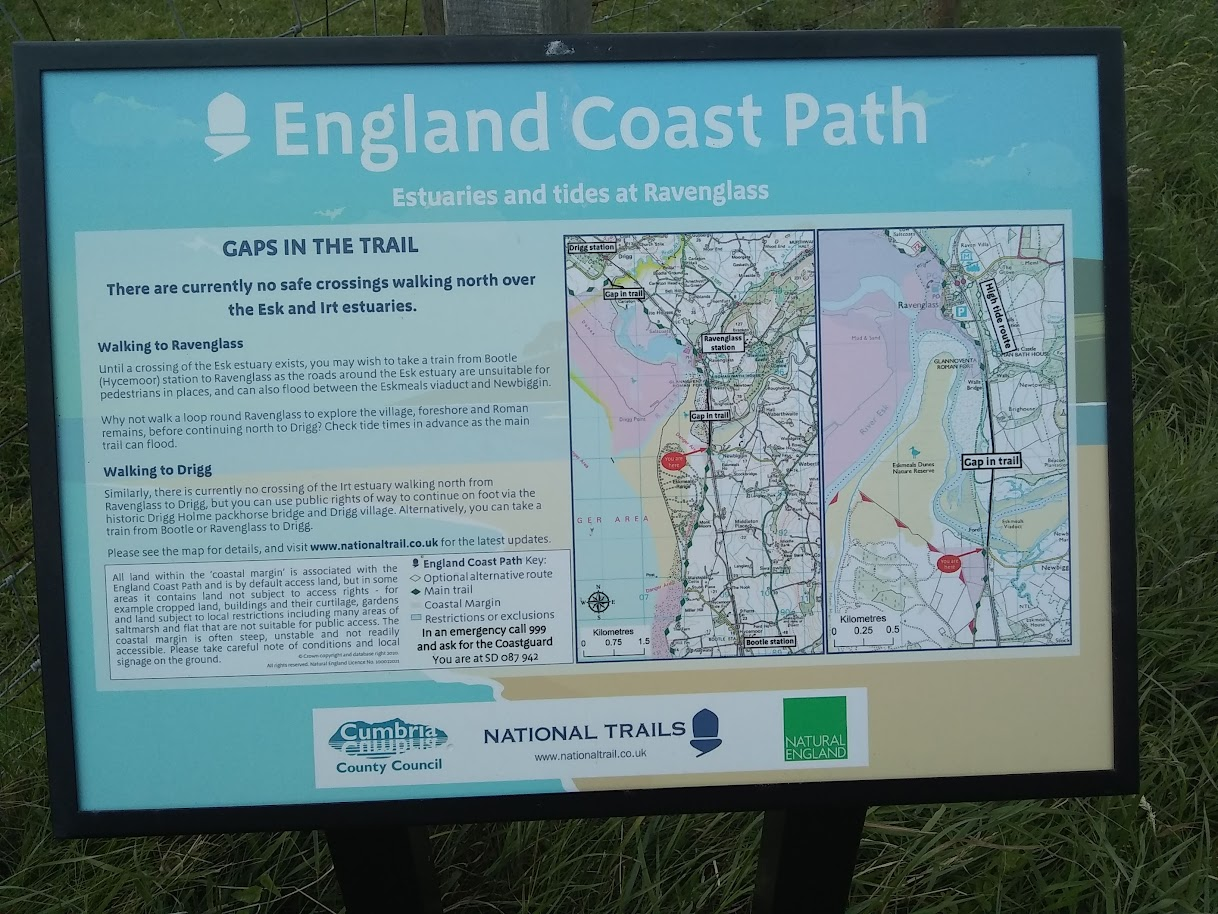
Looking at the map, there is a ford directly across the river. A Natural England warning sign highlights the tidal nature, and suggests that its untenable to cross until a suitable bridge is in place. This tantalisingly suggests that there is a plan for a bridge. 

So with the privilege of staying in the closest house, and a week to consider, I wondered just how untenable the crossing is. Surely it is a ford because historically people crossed here on foot as well as on horseback ?  A photo online shows a horserider splashing through quite shallow water.  But I can find nothing online highlighting how deep the ford actually is.

I was impressed by Ruth's walking blog, which describes getting between here and Ravensglass, a short hop across the River Esk. https://coastalwalker.co.uk/2016/12/08/eskmeals-range-to-ravenglass/  She however described, in November, the uncertainties facing anyone who thinks of crossing here, and indeed, also at another ford at Hall Waberthwaite further up river. She ended up walking 3 miles up river to cross via the busy Muncaster bridge on the A591, and of course 3 miles back down the other side. 

I should make a clear warning here. This is a tidal river, but also, being the Lakelands, the flows will be affected greatly by rainfall. Do your own research, be cautious, and be prepared to turn back. 

However, a quick look at the tide tables https://www.tideschart.com/United-Kingdom/England/Cumbria/Ravenglass-Beach/ told me two things. Low water was at 9am the day after I arrived, and that as this was near spring tides, with higher low waters as my week progressed. The Low water mark was 1.7 metres above chart datum.  High water at 2:44pm was 5.3 metres higher. My best chance for exploration was immediately.

As a student of sailing (you never graduate), I was able to check the charts.  The datum levels show the whole river drying, which is unlikely given the river flow. but perhaps possible at an Equiox. The 5M drying contour and the spot reading of 2.7M drying highlights that it should be achievable.(this is Navionics, but the Admiralty chart shows the same soundings).


From the kitchen window, you can almost see the crossing point, and at 8am, there was a quad bike stopped for quite a while. I had thought to take an early look anyhow, but perhaps I could grab local knowledge too. Sadly as I walked down, he was on his mobile phone, the scourge of enabling live conversations, so we nodded hello, and I walked on.   

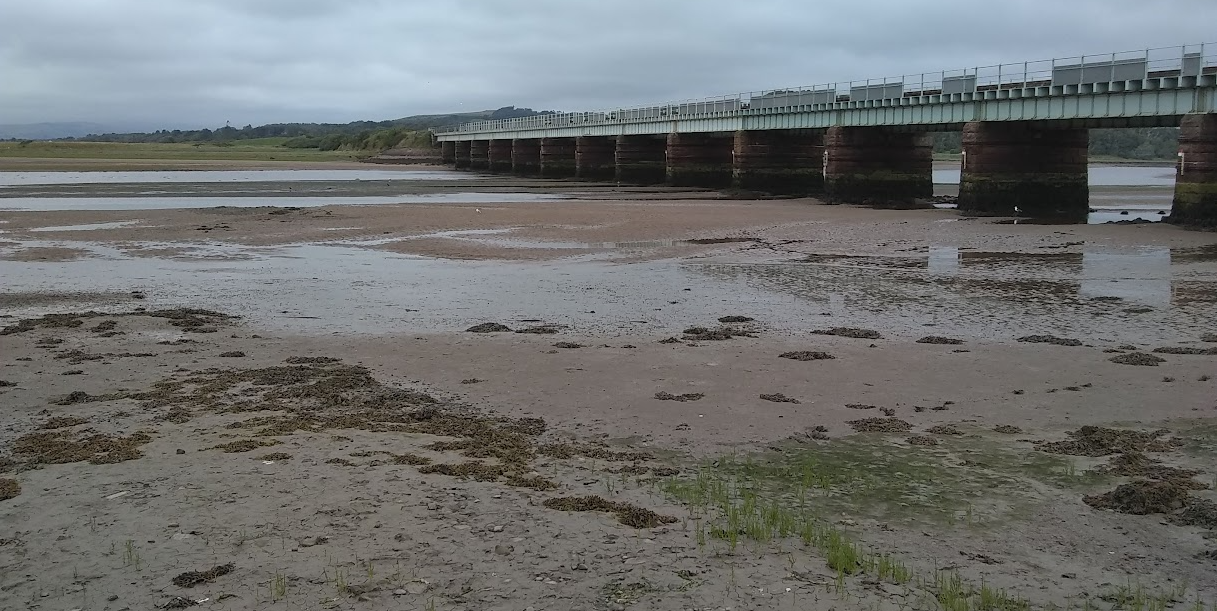
There is no usable depth gauge on the viaduct, but out on the nature reserve to the left, aside from the stone pillars of the viaduct, there is a fence row of concrete posts out into the water.  One hour before low water, it looked like this;


There are holes in the posts, I thought these might be a useful guide, but actually I couldn't see them later when I crossed. So half an hour later, I was back. Did I mention the warning?


Not knowing the nature of the bottom, and expecting mud, I had a change of shoes, maybe appropriately, Lakeland Aquashoes. And a stick to maybe test the way. Actually I could have walked it in my sandals.

This picture is halfway across. I didn't take the line of the marked "Ford", but somewhat closer to the viaduct. Not much more than ankle height wading to here. 

The second half is a bit deeper, but only came half way up to my knees. It looked like there was a deeper patch closer to the viaduct. The base of the pillars, and the posts between the pillars are perhaps helpful in assessing the depth.   


So having crossed the Esk with relative ease, I thought I'd look too at the Warberthwaite crossing. On a map of 1899 which hangs on the cottage wall, this is marked as a Roman Ford, perhaps part of the Military route from Lancaster via the Hardnock Fort down Eskdale to Ravensglass as described by R.G. Collingwood in a 1927 study.  

I started up the mudflats rather than joining the grandly titled Cumbria Coastal Way, but on joining it, I overshot the indistinct path to the ford, walking onto the permissive park track through the grounds of Muncaster Castle. So this picture was looking back downriver towards the crossing point. The actual line of the crossing is not clear, though the target, the end of the road by the houses is plain.
There were a couple of bits of wood in the river, that could have been withies, but I wouldn't guarantee they'll still be there after any flood. There was a fairly indistinct path to the waters edge, and a bit of a scramble down to the mudflats.
Its now 9:15am, so a bit after the low water tidal prediction that I had for Ravensglass. The flow is definitely still downriver, so I looked to cross at the widest point. On this crossing, the level came above my knees, just catching my shorts at one point. 

A scruffy barking dog greeted me as I climbed towards the bank. Once I had risen off the mudflats, it wandered away, returning to more quietly observe the invader again as I neared the houses. From here I took the path south to Newbiggen, which was mostly an attractive lane between two hedges. Here was the third and smallest ford, you could almost jump across it, but it seemed churlish to ignore the footbridge  provided.

But in turning right to take the photo above, I missed the footpath onwards to Eskmeals house, and returned instead via the road.

The slightly surprising thing, on returning from a subsequent walk on the nature reserve at around 12:30pm, was that the tide didn't seem to have come up by much. The fencing posts and central sandbar were both still visible. I didn't attempt, but it felt like the crossing would still be viable. I'll aim to check again later in the week.


From the display board at the ford, Natural England ran an EU Funded project back in 2016, part of the English Coast Path study, which determined that the ford is unviable, and therefore a walking bridge link across the gap is needed. It would have been good if rather than spending loads of money restating the obvious, they had perhaps just worked to made the link actually happen !  https://assets.publishing.service.gov.uk/government/uploads/system/uploads/attachment_data/file/360629/whitehaven-silecroft-chpt-3.PDF 

Likewise, in 2020, Network Rail did renewal work on the viaduct, including enhancements which could perhaps have usefully extended to provide public access.
"Engineers will also take the opportunity to upgrade walkways and handrails across the viaduct which are used by railway staff." https://www.newcivilengineer.com/latest/152-year-old-cumbria-viaduct-set-for-vital-repairs-08-06-2020/ It did also look like they had only painted half of the bridge.
Cumbria Council do seem to have an ambition to create a coastal link in their Local Cycling and Walking Improvement Plan (LCWIP), and this link does seem to be included in their West Coast Plans. https://cumbria.gov.uk/planning-environment/cyclingandwalking/default.asp  

In the longer term the county's flood and coastal defence strategy seems to leave this area, including the road at Eskmeals, to the lap of the gods.
Meanwhile, I guess the best way to experience the crossing is to do as the Romans did, to walk across near low tide.

When visiting the small church of Hall Warburthwaite, nestled right down by the river, where generations of the Falcon family of Eskmeals were buried (and the door has defences against sheep sheltering in the porch), there was reference to the church services having been arranged in previous centuries at times to enable the parson to ford the river to officiate, this brings up images of him hitching his hassock high, and braving a winter wetting. There was also a sign I had missed on the southern bank, which referred to the DEEP ford here. I mentioned that I'd crossed to a neighbour, who said that they enjoy it during the summer months, but she was surprised that I had attempted the higher crossing.  

I did go back on Friday, at about 2:30pm, some time after the predicted low tide. The water seemed even lower than before, and only came up to my ankles at the deepest part. The bed is slightly firmer following the line marked on the map  And this was how it looked.
 
I wouldn't recommend attempting it after heavy rainfall or in bad weather, and if in doubt, best to take the long road, but hopefully the descriptions and pictures above are helpful if you think of giving it a go. 


Wednesday, 16 October 2019

Renewing my faith in Renewable Community Energy

PTEP Logo
Last night I met at Bournemouth University with about 20 like minded souls all keen to contribute to responding the the Climate Emergency, and in particular, to whether we can create some form of community engaged and powered renewable energy supply for the Bournemouth, Christchurch and Poole area @BCPcouncil, and potentially wider Dorset.

It was great to see some familiar faces, including Pete West, who was previously Carbon Reduction manager for Dorset County Council, but now is one of the Directors involved in https://www.dorsetcommunityenergy.org.uk/ There is some impressive work quietly going on across Dorset, and we should build on that.

And with my colleague Karen Thompson, I relayed a little of the work that we have done under the Poole Tidal Energy Partnership banner (www.ptep.co.uk), though we did not succeed in building anything, we learned a lot.

To fanfare, @BCPCouncil recently announced that they were moving to a green tarrif for energy supply. This is under a national framework for Local Authorities run by Kent County Council, https://www.laserenergy.org.uk/, and one of my concerns was that the scale of this framework precludes the smaller, true green energy suppliers, in favour of the big 6, who are busy trading in carbon credits and other obligations, not just building additional renewable capacity. However, that framework does allow the council to generate and use its own energy.

Lots of comments about ensuring that the initiative is truly for the benefit of the local population, reducing fuel poverty, and not just some commercial exploitation, or indeed the council fixing its own energy consumption.

It felt like a renewal of ambition to do some good in this space.

Monday, 25 September 2017

Why do they target the 0.12% of road deaths ?

Wrote the following letter to my MP, in response to the plan to legislate against cyclists as the result of a single road death.


Transport deaths - perspective on proposed cycling legislation

Please can you bring the following to the attention of the minister;
Whilst shocked at the death of Kim Briggs , crossing the road on her phone, and  run down by Charlie Alliston, a cyclist riding a track bike on the road, I am saddened at the response of the media and the government in jumping to legislate for this very rare event (2 of the  1,730 deaths in 2015). There are a number of significant recent developments in distractions for all road users, and it seems, a heavy bias in failing to prosecute motorists who cause daily death on our roads.
The public health benefits of walking and cycling, both as active exercise for the participant, and to reduce congestion and pollution needs far more encouragement and investment, not constraining. (According to a Kings College study, there are 32,500 deaths every year from pollution related disease in the UK.  https://alumni.kcl.ac.uk/page.aspx?pid=4358)

Legislation in Western Australia (on mandatory helmets) significantly reduced cycling rates. To take an extremely rare occurance (it seems around 2 deaths a year are cycle/pedestrian collisions) and create laws in a knee-jerk way seems likely to result in poor legislation.

There are other significant changes to how highways are being used which seem to be relevant to this case, and to wider concerns. 
•             Use of mobile phones and headphones, especially by pedestrians which makes them far less aware of their surroundings
•             The advent of the electric car (much quieter than conventional cars)
•             Electric Bikes, which are heavier and often faster than many other cycles
•             The prospect of driverless cars, with no prospect to make eye contact and know intentions
•             Bigger HGVs with limited visibility, changes to higher visibility, low windowed cabs seems to be very slow to introduce
•             Less tolerance and more aggression from motorists
•             Parking across the pavement, cycleways, double yellow lines which is rarely policed.
•             The lack of consistent infrastructure for supporting safe and efficient cycling. Almost every road has two pavements, by contrast cycleways are rare, and often disappear at pinch points.
A balanced review should take account of all of these factors. I would not favour a jay-walking law, but as a slow cyclist, I often do get people stepping out onto the road without looking into my path, and I do think that there should be some balancing responsibilities.
At sea, there is an order of precedence, that motor gives way to sail (unless constrained by draught), and sail to rowing, but that for all vessels, they have an overriding responsibility to avoid collision.

There was another rather less publicised collision, where the cyclist died ;
Benjamin Pedley 26, cycling to church, died when a pedestrian Nathan Kellsall walked out infront of him in Earley near Reaading. Witnesses said that Kellsall had crossed without looking.
http://www.getreading.co.uk/news/local-news/family-tribute-reading-cyclist-benjamin-12861988 and http://road.cc/content/news/229584-cyclist-killed-when-pedestrian-stepped-out-front-him-may-have-been-prosecuted

This is on-top of many road injuries and deaths at the hands of motorists, many of whom walk free. Here are just a few that I’ve seen updates on in the last week;
A van driver jumping a red light who walked free despite consigning 15 year old schoolgirl Gemma Coates to a wheelchair.
http://www.birminghammail.co.uk/news/midlands-news/driver-left-schoolgirl-catastrophic-injuries-13648933.amp

Esme Weir, a 4 year old, scootering on the pavement with her pregnant mother in the Wirall. The driver had moments before waved them across the road.
http://www.liverpoolecho.co.uk/news/liverpool-news/delivery-driver-who-mounted-pavement-12782437 .

And a driver who killed a 4 year old boy on the pavement, blamed his diabetes, and shows no remorse.
http://www.birminghammail.co.uk/news/midlands-news/driver-who-mounted-pavement-killed-12343791

Despite Olympic success and a renaissance, cycling in the UK, it often feels to be a danger sport to share the road. Some motorists take delight in cutting you up, overtaking at all costs to join a stationary queue, and generally failing to give adequate space or consideration to a fellow human.
West Midlands Police, who pioneered a ‘close pass’ education tool for motorists, have seen cycle KSIs down by 20% in a year http://www.cyclist.co.uk/news/3490/cyclists-killed-or-seriously-hurt-down-by-one-fifth-thanks-to-west-midlands-close-pass
Examples of assault – either using the vehicle as a weapon, or a driver or passenger pushing cyclists off their bike are also too frequent.

Whilst it seems one of the suggestions is mandatory training for cyclists, much of the behavioral problems are displayed by motorists, mandatory cycle training as part of the driving test would probably save more lives.

Apparently a wide-ranging review of all road traffic offences and sentencing was announced by the government in May 2014. This evidence based approach seems to have become stuck. Acting only on cycling ignores the cause of more than 99% of road deaths to focus on just 0.12% of them.

Please could the government focus public resources and limited legislative time on the offences with the propensity to do the most harm and bad behaviour, not “a populist yearning to ignore inconvenient facts and rush to judgment” (quote attributed to Jesse Norman MP)

Friday, 20 March 2015

Stop the killing on our streets


Last autumn I stumbled on the group Stop Killing Cyclists, which thanks to enormous effort from a small group of people has been getting quite a bit of press of late. I attended a rally in London (first time ever), and was moved by the quality of the discourse, and the determination of people to persist in cycling in the busy capital, and to speak up for those who no longer can. I have long campaigned for improvements to infrastructure to make our streets safer, and here are a bunch of like minded folk.

But the carnage of both pedestrians and people on bikes continues, most especially crushed by lorries, with drivers perched so high up that they can't see those immediately around them, and often don't even know what they've hit.

Two particular shockers this week. One was an inquest into the death of a care worker cycling in Dudley, where the reporting seemed to blame her for 'racing' a lorry which from the account arrived at the junction after her, and turned left over her.

http://www.expressandstar.com/news/local-news/2015/03/18/cyclist-killed-trying-to-beat-lorry-across-junction/

But the police decided not to prosecute the driver. The Coronors verdict “I have heard from a number of eyewitnesses who have said it appears that Mrs Rowson was trying to beat the lorry. Sadly there was a collision and she was pulled underneath the vehicle and received extensive injuries,” Mr Saddique said.

This was not some lycra clad road warrior, but a 51 year old mother. The only racing she was likely to do was in rising terror as she realised what was unfolding. The Police, Press and even coroner seem to have turned to victim blaming this poor woman.

And the second was the treatment of the family of Michael Mason, a 70 year old killed on Regent Street in London a year ago, hit from behind by a woman who claimed not to have seen him, when all the witnesses around had. It was night, with plenty of streetlights, and he had working bike lights. But the police made much of the fact that he wasn't wearing hi-vis clothes, and had no helmet.  Neither of these are mandatory, and helmets are only actually effective for minor collisions anyhow. A pantomime of whether they referred the case to the Crown Prosecution Service ensued, and the family now plan to mount a civil prosecution since the police have entirely failed this man.

http://road.cc/content/news/146081-metropolitan-police-admit-they-didnt-refer-cyclist-michael-masons-death-dpp-five

But the bigger question that both these cases illustrate, is that in any other incident - whether transport related, work related, or an unexpected death, if I operate a machine and kill someone, the suspicion of guilt would fall upon me. Innocent until proven guilty yes, but properly investigated and due process undertaken. With Rail, Marine or Air Transport in particular, meticulous investigation would show and seek to learn from to eliminate any flaws in design of the vehicle or infrastructure.

This just doesn't happen on the killing fields of the highway. It is inexcusable for lorries with such enormous blind spots to be on our roads. Yet we know the many flaws with our road layouts, which over time could be reduced. Legislation for the redesign of lorries has been passed but deferred for years. Mixing traffic at different speeds and weights is avoided in Holland, and the variable quality and maintenance.

If I run down the road with a scaffold pole, clearly I am duty bound to avoid hitting anyone. If I do it with my car, or worse a big lorry, it seems is just treated by the police an accident, and especially if a cyclist, their lookout. This is outrageous. People should be accountable to be in control of motorised vehicles, and not be so readily excused for their actions or inattention.

In other news today, a number of main A roads are to be turned into mini-motorways, with slow traffic - cycles and tractors banned. Many of these A roads pass through towns, past houses, splitting communities.

The Stop the Killing alliance make 10 clear demands for change to protect those on foot and on bike. These are urgent. It is March 2015, and 14 families have lost loved ones to untimely deaths this year already.

Saturday, 22 November 2014

Response to New Forest National Park antipathy to Cycling

In response to the New Forest Management Plan, http://www.newforestnpa.gov.uk/ManagementPlan  whose only provision for cycling was concerns about large groups, (deadline for submissions 19th Dec 2014), I submitted the following;

I was born on the edge of the New Forest, at Highcliffe, and spent many happy days in my childhood cycling into the New Forest (even at quite a young age). I am now 50, and living in Poole, so a rarer visitor, but far more likely to come with my bike than otherwise, and have occasionally cycled with my family.

I am shocked by the current negative attitude of the New Forest NPA to cycling. I know that a grant was revoked because of this, and that there are certain noisy interests who are anti-cycling, but surely it is the duty of a National Park Authority to balance all interests, and in particular to contribute to the really important work of reducing childhood and adult obesity by encouraging all sustainable activity through the area.

I understand the conflict that large scale events can cause, but the forest is big enough that it really should be possible to manage such things, and core to the values of a national park.

 DEFRA's guidance document English National Parks and the Broads: UK Government Vision and Circular 2010 says: "Parks are attractive locations for large-scale community, charitable or other events and festivals such as organised charity walks, cycling events, cultural and musical events and fairs."

Your management plan talks about supporting sustainable travel options, but then only developing the bus services, to reduce car arrivals by 5%. This ambition is very limited.

In particular, I do not see how the refusal of bike hire facilities or silence on any other enhancements ties to the concern about big events (which seems to be the only mention you make of cycling in section 4.20 and 4.21).

NFNPA should include proactive measures to enhance the leisure use of the Forest by bike for families and small groups (especially using the train stations as entry points, but also potentially encouraging bike racks on buses through the Forest), and rather than just look to "control" cycle events (do you do the same for walkers, riders, car rallies), aim to work out routes and potentially adding tracks to mitigate pinch-point locations.

In your 5 year plan I would like to see positive measures to encourage all sustainable travel options, in order to justify the designation "National" Park, your public funding, to balance the needs of all potential park users, and to contribute to mitigating the obesity pandemic.

Andy Hadley, Poole

Sunday, 28 September 2014

A better approach to transport through the heart of Poole

Text of a letter to the leaders of the Borough of Poole Transport Advisory Group
Cllr Ann Stribley, Cllr Tony Trent, Cllr Ian Potter (Portfolio holder), Cllr Mark Howell, Cllr Mike Brooke. cc Julian McLaughlin (Head of Transportation)

Dear Councillors.
At the last Transport Advisory Group that I was able to attend, Cllr Stribley challenged her colleagues to think strategically about the transport network in Poole. I very much welcome that.

In particular, if you look at other conurbations and cities in the UK and overseas, there is a groundswell of change which seems to have passed your officers by. In London, 24% of peak-time journeys are now undertaken by push-bike. Of course the congestion charge, the investment in Boris bikes, increased cycle-friendly infrastructure, growing traffic congestion, and the global recession will have all played their part. The Mayors office, and Transport for London have worked hard to achieve this modal shift away from car dependency, and it is now paying dividends.

And other communities and authorities in the UK have taken a very active part in striving to rebalance, and to reduce the over-dominance of motorised transport, in particular removing key barriers to easy, efficient and safe pedestrian and cycle movements. The Birmingham Bullring has gone. Several significant gyratory systems in London, including that at Aldwych have been unpicked. Cities and towns like Brighton, Southampton and others have thought systematically about how to improve the health of their citizens by cutting motor-traffic pollution, and encouraging the exercise and other health and economic benefits of lower impact travel.

In central Poole, we have the benefit of some of the best weather in the country, and mostly fairly flat terrain. Some of the away from road cycle routes, especially with water frontage are a joy to be on.
The Borough have taken steps when maintaining or redesigning to bring in some helpful measures, although maintaining minimum safe widths seems to be a struggle. But when not actively building cycle schemes, and where it gets difficult, more harm is being done to the actual and perceived safety of using the network, and this fails to persuade people of any age to walk or to get on their bikes.
We should learn much from the Scandanavians and the Dutch. Moving to the current position in Holland, where many people of all ages and abilities cycle regularly, was not painless. It arose in the 1970s via a campaign "Stop killing our children", which reclaimed public space from the dominance that has emerged with ever more cars on the road. A similar campaign has now started in London. We know that the majority of journeys are less than 5 miles, and that if you build, people will come. Just as roads like the Newbury Bypass have generated increased car trips, the nature of what we design around the West Quays will dictate what people choose to do. 

If the designs enable connectivity, convenience and safety for walking and cycling, then people in the new developments on both quays will be encouraged to make their short trips that way. If, as seems currently the priority, all traffic modelling is based on shaving seconds off car journey transit times, the car will continue to dominate the town and to sever the community, especially with the planned gyratory option.

But also, taking a strategic view, West Street, West Quay Road, and the crossing ways present the hub of the entire network for any means of getting about across the heart of Poole. The National Cycleroute crosses at Hunger Hill, the Heritage Cycleway crosses by the RNLI, and many staff working for the significant employers around the town and Hamworthy already walk and cycle through here, and have indicated that they would be more likely to if the links were improved. Allowing poor design in this area sets a constriction on many of the short journeys that could be undertaken on foot or bike across the town. Locals would be encouraged to forgoe the car for their shorter trips, which will be better for their personal health, and for the economy and vitality of the town. Achieving modal shift away from the car will free up the highway network for those trips which are essential to the economy and life of the town including the Port operations.

And it is not just about transport, but also place. What impression of Poole do we want visitors to leave with ? What environment do we want our kids to grow up in, what neighbourhoods to encourage people to move into ? Key employers in the town have expressed embarrasment about the appearance of the gateway for customers and potential investors.

I believe that if you want to think strategically about the future transport network throughout the town, the West Street/West Quay Road presents a key opportunity for a step-change. You urgently need to direct your transportation department to
a) go and take a very good look at some of the towns and cities I have mentioned, and how they are rebalancing space to achieve modal shift, and living space.
b) download and read the many good design documents that Transport for London have commissioned, in particular I'd recommend https://consultations.tfl.gov.uk/cycling/draft-london-cycling-design-standards/user_uploads/ch3-cycle-lanes-and-tracks.pdf. These are a pale imitation of good Dutch design, but highlight what should be achieveable now in the UK.
c) re-read the independent review that you commissioned of the gyratory plans, and your own strategy documents that seem to lie ignored and buried.
and d) abandon the gyratory plans, and modify the two way proposals to take far greater recognition that journeys undertaken by foot and bicycle are likely to be far more economically beneficial to Poole, than encouraging racetrack mentality and transit by car to elsewhere.

Because there just is not enough space to keep building for cars, or pretending that this is good for individuals or the population of Poole.

Andy Hadley
Transition Town Poole

Saturday, 4 May 2013

bugs and bees

A great week for bees, with the 2 year EU moratorium on neonicotinoidal pesticides. I was mowing part of my lawn (I do it in stages to give frogs and wild flowers a chance), when I saw a couple of bees on the fruit trees. Only a couple mind.

Last year was poor for fruit trees, I think the blossom was rained and blown off before the pollinators had a chance to do their work. We've had some sunny weather, and my Pear tree seems to be blossoming late, the cherry is in full flower, and the apples are catching them up. I hope there are enough bees around to visit all the flowers.

With a small urban garden, though I am strictly organic, I am at the mercy of what my neighbours do when it comes to pesticide and other influence on bees etc, which is why I personally am pleased at the EU decision. (as well as the wider impacts on colony collapse and agriculture). Sadly in a domestic setting the stocks in a single bottle may outlast the short term ban, but hopefully the gap will create some scientific evidence as compared with countries outside the EU which carry on using neonicotinoids.

And so to bugs, or rather slugs. My lawn is full of Dandelions, which I try and fork out before mowing, and risking spreading the broken leaves to re-root (I am sure this is just because my mother dealt with them this way).  A week ago I pulled one dandelion out, and left it by mistake on the lawn. So when I came to clear the shrivelled remains today, two things struck me (that I have seen before). Firstly, all the flowers had turned to seeds - how does it do that ? clearly an advanced panic reaction to preserve the next generation, or at least give it a chance. And secondly, there were loads of small slugs gathered around. They really are good clearance agents for the lazy gardener, Whilst I hate them taking my seedlings (or as currently eating my coriander and parsley in the greenhouse), I mostly stick them on the compost heap to help create new soil or maybe provide birds with some food.

Pleased that there are coal tits in residence in one of the bird boxes on the back of the house. I wasn't sure whether it was too exposed to be useful, but it is certainly out of reach of the far too many cats around here. Sadly the robins that were obviously feeding in a different box have stopped, and I fear our cat took the fledgeling.  

Sunday, 27 January 2013

Pork and Apple

Pork and Apple


I feel I have failed my apple trees this year. Everyone it seems had a poor crop. We have a tree with three varieties on it, which the lady at the nursery didn't really want to sell "because they are troublesome", but that's not been an issue. The Cox branches didnt bear much this year, but despite the general dearth, the golden delicious seemed to be relatively quite a bumper crop.


And I did pick some. They were a bit scabby, and this is my least favourite variety, so I ate a few, but I am afraid they mostly sat in the conservatory, unloved, going wrinkled. Many more fell from the tree, and lay where I could see them from the house, challenging my ineptitude. Last year, we made cider, and chutney, and I took apples to work every day for months. What went wrong ?

I did console myself because quite a few showed signs of pecking, enjoyed by the birds through the harshest days of the winter. The blackbirds in particular seem to relish them, and they keep going on an individual apple until it is quite a hollowed out shell. The slugs enjoy them too, part of natural decomposition, though there is too great an abundance of them.

But now, with the first warmth of spring sunshine, and before the blossom starts to form, it is really time to clear the ground.

My friend Dominic keeps a pair of pigs in his garden, or rather he fattens up pigs over the winter, this being his third brood. On Christmas day, when we were round for drinks, admiring his 'boisterous boys' from the safety of the house, I mentioned my crop. The pigs go for slaughter in a couple of weeks, so today was the day to take them an apple treat. 

It feels more worthwhile than just composting, and maybe a late appley diet will enhance the flavour of the pork. Last year's tasted good, and they only got the cider pressings from me !

Monday, 7 January 2013

Shoreham powered by the sea

Well almost, its a ground sourced heatpump


I've been keeping an eye on exiting developments at both the National Trust and the RNLI, as part of my 'hobby' as a director of Poole Tidal Energy Partnership. Both these venerable institutions are canny with their funds, all raised from volunteers and public subscription. Both are actively looking to reduce their carbon footprint in innovative ways, and are investing in heatpump technology.

http://ntenvironmentalwork.net/ is a great blog. In particular Keith Jones, responsible for the whole of Wales plus Northern Ireland is looking at all forms of renewable power including a seawater powered heatpump for Plas Newydd on the Menai Straits. Keith has enlisted the help of several Welsh Universities (the Seacams project) to help map and plan the development.

And the RNLI, with its headquarters in Poole, has by nature of its work, water always close to their doorstep, and have tested and installed a number of heatpumps - ground and water sourced.
http://rnli.org/aboutus/aboutthernli/Pages/Environment.aspx summarises their approach, but we have been talking to them for a while.

So it was time this weekend to return my son to University in Brighton, and I thought I'd drop by the Shoreham Lifeboat station, which has a ground-sourced heatpump.

The volunteer in the shop initially looked a bit crestfallen when she offered to show us around and I told her my particular interest, but entirely through luck, she said the station manager (another Keith) was on site. We met him on the stairwell, he had just been entertaining crews from other stations. He was happy to show us down to “the cave”, not normally on the tourist trail, where the heatpump sits. The machine is the size of a small washing machine, and they said it heats the station very effectively (the white tank is a temperature stabalising device). We were taken into the crew room, and it felt very warm – he said without needing to use the top-up heating. Indeed (and I had spotted it on approach), although it was a cool January day, they had some of the windows open on the top floor.

This is a groundsource system, with 3 boreholes going straight down 90 metres. Robert from RNLI HQ kindly filled me in on the details, this was the second station that they installed. The basic design of boreholes is based on the idea that roughly 55watts of energy can be extracted per meter of borehole. Therefore 3x 90m boreholes gives 270m of collector which multiplied by 55watts equals 14.8kW. – Allowing for a little safety margin in the design this is the peak power output of the heatpump. Given subsequent experience, they might have taken a different shallower approach, taking benefit from the groundwater adjacent to the eastury.

Really grateful to both Keith at the station, and to Robert at HQ for their hospitality and insight. Tomorrow we're presenting our ideas to councillors, and it is really helpful to know of solid progress from trusted organisations.


Saturday, 29 September 2012

Feast or famine year

Where did the summer go ? What summmer...

This morning, almost the last day of September, I sat for a short while watching a spider carefully spinning her web. It is so easy on these autumn days to sweep aside their precision engineering, when hanging out the washing, or in search of an apple from the tree. Often I try to negotiate under, over or around the web, only to completely forget on my return trip, breaking their world.

Along with most people I talk to, the garden has really been unproductive this year. I popped down to the community allotment, having missed most of the fortnightly workdays since spring. The grapes in the greenhouse have once again been a bumper harvest, and there are late raspberries to pick, and a few squashes nestling on the beds.
   

A Red Admiral butterfly alighted on the bench, and fluttered off, too quick for me to photograph. This year, there seems to have been loads of them feeding on the plum tree at home. I guess they rely on the birds or slugs to break open the skin, but must then be attracted by the strong scent of ripe plums. I haven't seen this feeding frenzy before, but I think I heard that they have forsaken their customary migration southwards to Africa in recent years, presumably preferring to stay and gorge on our autumn abundance and then try and find a warm place to overwinter. Given this year has generally been bad for wildlife too, it was heartening to see.

But whilst vegetable gardening has gained great popularity, the effect of failed crops for us is just to resort more quickly to supermarkets. They will be quick to inflate their prices, both with real costs that they bear, and probably opportunism to boot.The impact for those who depend on either growing their own food from necessity, or growing to provide a modest income, is probably a different prospect, much as the feast or famine that our forefathers faced. Whilst we maybe should count our blessings for not relying on what we can personally grow, the planetary impact of our lack of self sufficiency is a perpetual worry.

Monday, 21 May 2012

Bikeless - so inconvenient

They always say you appreciate something more when it's gone. Some lightfingered soul pinched my bike and trackpump from my garage on Sunday night, leaving me in more distress over how to do the journeys I need to cover this week, than over the loss of the bike itself.

Although it was only 3 years old, we've covered quite a bit of ground together. No great journeys, but lots of little ones, across the heath to work, on the train to and around Dorchester and Bournemouth for work, and many times to the allotment, sailing and meetings around Poole.

And the simplest of things. Yesterday I had to go to Dorchester for work, and I'd forgotten that I had also promised to go to a GP surgery in Poundbury to help sort a problem out. Easy and quick to pop over on the bike, but bit of a long trudge by foot. Today I was up early for a long train journey to Cambridge, and walking to the station, misjudged and arrived for the train before the one I intended (and was meeting a colleague on). And for the rest of the week, my plans for cycling to work and evening meetings in the promised heatwave are now dashed.

Its so inconvenient. I can afford the loss, the insurance may pay out, but the logistics and distress are the bigger issue. There is violation of space. Someone avaricious sneaking around, dismissing most of my junk, but seeking which of my things they can turn into their cash. And probably at such a poor rate of return, compared to the hassle and cost this causes me. 

Momentarily despair of folk, of spending my time trying to make my corner of the world a better place for people such as this. If it were my car, there would be so much more that the police could and would do, but my prime mode of green transport doesn't register beyond 'another one' on their radar.

Saturday, 14 April 2012

Harvesting rain

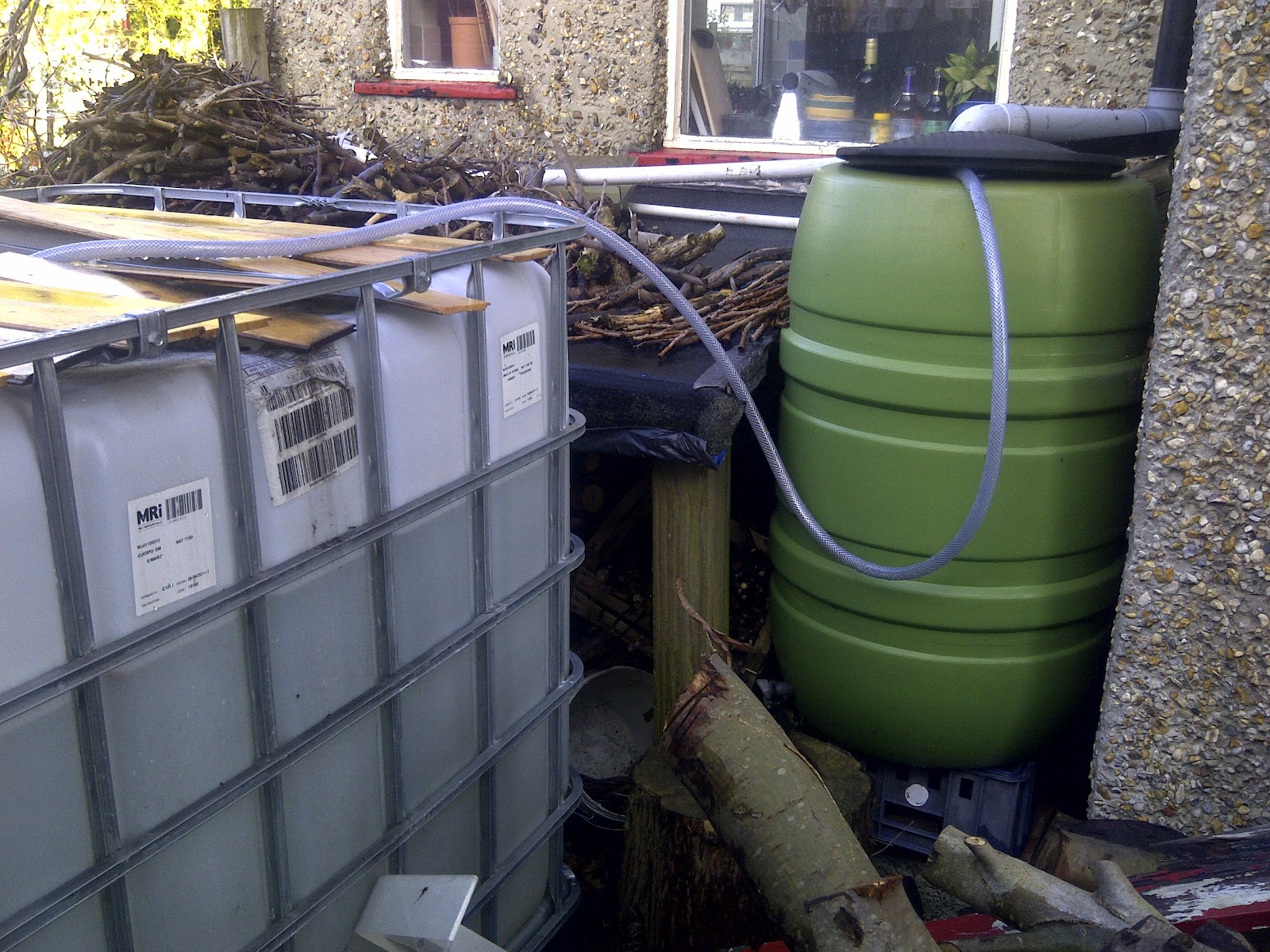
We've done quite a bit of rain harvesting at the Tatnam organic patch, and I it try at home too. I have 5 water butts, connected to different roofs, and when a kind donor offered an IBC (1000 litres), I jumped at the chance.

And then it was delivered to a friend's and quietly forgotten until last weekend, when he was under orders to clear up the garden. My planned location involves moving 3 compost bins, a significant haircut for several bushes, and moving stone and existing waterbutts around, so instead I plonked it on the drive, next to one of the two linked water butts that seem to instantly fill whenever it rains, as the whole downpipe from a significant part of the roof empties into one of them, whilst a rainsaver tops up into the other.

It took a while and several attempts to get the syphon sorted (for this temporary location), but that done, the result was that two linked waterbutts were much depleted, with rain forecast.

And only today, when I happened to be home having dodged a shower, did I notice that much of the rain was pouring down the outside of the pipe due to a docking failure way up high, and also that the watersaver from the other roof was not doing its business.

One of the joys/hazards of collecting rainwater is that it is best tweaked when it is, er, raining, and so you get wet. The rainsaver was full of leaves, now why didn't I sort that on a dry sunny day ? And finding a short section of guttering (lying within reach of the problem) I soon sorted (or should I say bodged) the downpipe escape. All fixed, so inevitably it has now stopped raining. Ah well, the next shower I will catch. And a cautionary tale to clean it out if you haven't checked your rainsaver recently. They do tend to catch detritus perhaps more efficiently than rain !

As a sailor, I do find the www.windguru.cz website great, but it is also good for the garden, as it predicts the rain quite well. Plenty more rain is forecast for later in the week, before I know it, everything will be filled, and (I think) it will be touch and go on whether the IBC overflows before my downpipe.

The other job I got around to was to provide some shade for the IBC. This is to try and reduce green algae growth in the tank. Had I purchased, I'd have gone for a black tank to avoid this problem. I have some thin tongue and groove, secondhand, and varnished on one side. Since it was cluttering up the garden, a bit of sawing, and the top is roughly covered. Which reminds me, I left the saw outside. Better go and retrieve it.

Postscript: Gone back out tonight to take a picture, it is a bit messy, and it blocks my woodstore, but there's a great permaculture principle that Gary often quotes - get a harvest. And if there's a dry summer ahead, I have over 1000 litres already in store.

Transport blues

Every time I need to take a journey I do try and look at the alternatives, and one has to conclude that despite the rhetoric, the UK government are either impotent, complacent or complicit in making it very hard to be green, and making public transport options far too expensive.

Of course the green sages would say don't travel. Well maybe the world comes to them, but for work, I need to go and see how the hospital at St Helens and Knowsley are managing the transition from paper records to electronic practice. In their case, Electronic document management, ie scanning the paper and showing the result on screens as much as possible.

It's a trip organised by our local acute hospital, so we started with 'the project manager will be flying on this particular flight from Southampton to Manchester, who wants to share a taxi'. Well, for team building and being in the meeting at the right time, we all would. But for sustainability, internal UK flights really shouldn't feature.

So I looked at the train. From Poole, there used to be several direct services a day to Manchester, Edinburgh and other points north. To convenience the train operators, they were allowed to truncate services some years ago at Bournemouth, saving 5 minutes off the journey, (or even Southampton for some services) but meaning changing trains and wasting between 1/2 and an hour waiting. Targets and stupid privatisation of the railways.

The 05:00am train (crikey, I'm used to getting up early if I have to, but not that early) would, via London, get me to St Helens around 10:30am. No wait, that is £100 more expensive than the plane. Avoiding London is £2 cheaper than the plane, but gets me there at 11:30am.

So despite wishing to do the right thing, I am booked onto the flight. I'll take that same train from Poole to Eastleigh Airport at stupid o' clock, but should be at Manchester about 8am, and then a taxi.

And then I found that the meeting is due to be 09:30-2pm, so my train options would have made me very late. Or to get there on time, spend the overnight 5 hours on Birmingham New Street station (which I did after a Genesis concert years ago).

When you look at the options that are available, they are all rubbish. And our government seem set to make them less attractive. I am not a great fan of the idea of High Speed Train, (I prefer more frequent trains across the network) but time is an issue when working, and the logic is not green at all. :(

Thursday, 15 March 2012

Dorchester Community Farm

I work quite often in Dorchester, and lunch is often a rushed affair between meetings, sorry to say with a cheap sandwich from a supermarket. But I do try to at least take a little time to visit a quiet corner of town, where the green shoots of Transition are growing ever more strongly.

Under Lache Farm was a green and somewhat windswept field when I first visited, with some markings for a pond and a row of dry raised beds. We were asked and tried to gather support from Transition Poole to go and help erect a polytunnel with them. Sad to say, when it came to it, after several delays, only Cherry and Andrew managed to get along to help.

So I was delighted this week to pop in, (no-one was about), and to see the polytunnel well stocked with winter salad crops, 10 inquisitive chickens running across their coop to see me, and a stand of four 1000 litre IBC containers which look like they have been connected to the drainpipe of the roof of the industrial unit next door. They are making brilliant progress, and far more organised than we tend to be at Tatnam Organic Patch.

http://www.transitiontowndorchester.org/category/community-farm/

Sunday, 27 November 2011

Wood work

I nearly bought a wood this week, well, I got as far as enquiring about it and seeing whether anyone else was interested (two friends were), before finding it was gone anyhow. Learned some interesting stuff, some financial; that woodland is between £4,000 and £8,000 an acre, and is free from capital gains tax, but also exploring some more interesting questions- why would I want a wood, and what would I do with it. And what about others ?

I'd want to crop some wood - but then I still haven't bought the woodburner I was looking at in September. I'm good at collecting wood, not so good at consuming it. I'd also want to encourage wildlife, to plant new trees, to pollard and watch nature taking its course. To feel that the land was being productive and protected, contributing to the balance on global warming, a lung ideally in or near to our conurbation. Which the wood I'd found would have done, but it was a bit scrappy, and out near Ferndown, a bit of a way away. And most of all, learned that if we are to secure some woodland, we'll have to be ready to move fast. And ownership of space (other than one's home) is a concept that I struggle with. Stewardship, and safeguarding for people to enjoy/use now, and to preserve for future generations is more important.

On my driveway, I have had a pile of twisted willow that I cropped last autumn from the tree in my back garden, the second time I have pollarded it. The first time around, I chopped the many branches into short sections mostly for kindling, but something Andrew Hope mentioned in a Transition meeting made me consider how wasteful that was. He suggested, especially with reference to pine wood, full of resin, that it would be advantageous to make rough garden furniture, use it for 10 years, and then burn the wood. Although my willow for the fire involved zero fuel miles, I could do better.

And quite a while ago we had gateposts planted, on the basis that we'd go out and buy a gate to match the lovely sunrise gate that Clare designed and a local gate-maker constructed so long ago that it is now falling apart and needs to be dragged open and shut. But we never have. So, I finally got around to some sort of construction,


Of course the great thing about working in your front garden is that there is the possibility of conversations with neighbours (assuming they are not shooting past in their cars).  I am not sure which of the two comments I had whilst hanging the gate was more helpful - "Ohh that's rustic" said one, and I think it was genuine. The other,  whilst I wss busy attaching the hinges, suggested that it wasn't straight. She giggled, and it's true, but sorry, it never will be straight.

In the sense that I have done more than one half of the first driveway, I'm over a quarter the way there. How long it takes to turn the rest of the stacked wood into the other gate, and how I stitch the halves together, or whether the design is consigned to the fireplace, time will tell ! And I'll have to wait awhile for the regrowth to replace the sunrise gate, assuming it lasts that long.

Wood grows on trees, but not instantly !

Friday, 4 November 2011

Greek Tragedy


It is indulgent Sailing on the Ionian shores of Greece, but when living for two weeks aboard a small yacht, you are conscious of economy of use of water, electricity and fuel. And each port we visited gave insight to the locals resilience, and sadly the effect that sun-seeking people from Northern Europe (mainly Britain and Holland as I saw) are having on the landscape and the population, and the way they use their land.
We sailed some of this area about 10 years ago, and Petriti on Corfu, one of the least developed ports on the island, provided perhaps the greatest contrast. It is still described as an unspoilt fishing village, with a few tavernas, and the harbour is still mostly populated by fishing boats, ranging from the unbelievably small to quite sizeable craft with an array of lights to lure the fish to the surface.
There were several fishermen on the harbour wall, using techniques I had never seen using a rod to catch a small fish, then attaching a hook on a hand-reel to the live bait, getting the fish to swim out in search of bigger fish. These may have been leisure rather than commercial anglers, but one in particular was there all evening, and back at first light, with several hand-reels on the go.
Last time we were here, there were a few smart villas, but most of the houses were modest, set in fairly large grounds, with citrus fruit and olive trees, livestock and woodpiles, a ragbag of tools and toys around the yard, and evidence of the family links with the sea. But now, many of these have gone, replaced by far larger buildings, several to an old plot, with far less growing space.
In the centre, close to the harbour, is a field, full of ancient olive trees, pollarded to around 3 metres high, but as thick as adjacent olives 10 times that height. A couple of handmade 'for sale' signs in English and Greek were nailed to trees. There was a woodpile, a tethered donkey, and a load of chickens and turkeys roaming the site. In one corner was a small shed, and an old wooden boat. Walk around the plot, and a big hoarding announces yet more luxury villas. As a sizeable plot, this will be a whole estate before long.
At a time when we are coming to recognise the values of pastoral life, those who still have this in their grasp are being lured/forced to sell up their greatest asset - fertile land, to plant sterile buildings on. It is ironic that whilst we were in Greece, there were general strikes, and riots in Athens over the planned austerity measures, and yet truly sustainable (if subsistence) existance is being pushed aside to support affluent leisure.

Thursday, 27 October 2011

Inter-regional funding possibilities - La Manche

The possibility of European Union funding for the Poole Tidal Energy Partnership lured Paul and I to a meeting at Southampton Solent University. 


It was interesting to see how Southampton pitched themselves as the centre for commerce and research on all things to do with the sea, but we made some good contacts, both with those across the channel (the aim of the meeting), but also with some UK agencies that I had been meaning to contact for a while, and with other UK South Coastal people.


I had not before been involved in a conference which was translated real-time. Given the topics were fairly technical, and my rusty French, it was great to have someone deftly convert.

Whether we can get a collaboration going, and get funding is of course something we will have to work on

Tuesday, 5 July 2011

Energy in all its forms

I have been quite focussed on energy given Transition Poole were asked to lead the bid to Energy Share for Tidal Power in Poole Harbour. Think it is a great idea, although I have a slight worry about whether the energy levels are scalable to enable us to cover the inevitably long-drawn out and costly environmental and other work. Will update our progress over at http://transitionpoole.org.uk/?page_id=725 We have made a great start, and raised lots of local interest.

I spoke at the planning inquiry back in the spring into the 4 wind turbines at East Holne, to the West of Wareham. Initially approved subject to conditions http://transitionpoole.org.uk/?p=541 Bitterly disappointed that the nimbies subsequently squashed it (some coming from so far away that they needed maps and directions). So short sighted. I suspect the developer will win on appeal and certainly deserves to in my view.

Am interested in the Eneco offshore wind proposals for West of Wight/Dorset Coast. These can be seen  at http://corporateuk.eneco.nl/outlook_and_strategy/innovation/Pages/TheEnecoWindPark.aspx No specific details as yet.

I would much rather this off our coast than any reliance on nuclear power stations, yet am partly worried about their proposal for the following practical reason. I passed through this whole area on my only trip to France in my boat on the way in deep fog, and on the way back in a howling gale. Arrays of solid poles to hit limits choices for a small yacht.

Also, was alerted today to an interesting series of articles about renewable energy inteligence http://eeru.open.ac.uk/renew_online.htm.

And I have finally got around to talking to a local company about how I can better insulate and heat my drafty old house. Great chat with a very knowlegable supplier, who confirmed some of the things I had thought not worth doing, and identified several principles I had partly worked out. Although I was left at the end thinking - you haven't measured anything closely, and you haven't given me any prices.

So I popped in to their showrooms on my bike, in the rain tonight, just before they closed. Very helpful, but Simon, another Poole Transitioner, who shares meter readings on the imeasure.org.uk website, was also there looking at woodburners. It seems the competition is on !

Friday, 17 June 2011

Tidal Power

A meeting tonight at Bournemouth University, talking about a community project to potentially trap energy from the tides in Poole Harbour. If we can get enough supporters to sign up.

Lots of interest from relevant official bodies and others around Poole, and the university are keen to participate. Quick turnaround required for the bid process.

If you can, please support us before the end of June 2011, click the 'support this group' on http://www.energyshare.com/poole-tidal-energy-partnership/

Weymouth to Dorchester Relief - not quite

From the station at Upwey, there was no indication of which way to the relief road. I had an inkling that it was towards Littlemoor, so I headed through the railway arch and eastbound. Not too far on, and the road started to rise, the bridge over the new road. There was a large path down to the left - no markings as a cycleway, or that it led to Dorchester. Must be it.

The first part was good - a wide and very flat tarmac path running around the outside of a large lagoon presumably constructed to take surface water from the road. This all looked very raw and bleak, I am sure the willows will arrive of their own accord, though attaching to the sloping black plastic will be a challenge. Too soon it bent back to the road, and then too close for pleasure. Traffic engineers seem to have no concept of separation, or the need for oxygen rather than Carbon Monoxide, and some screening from noise and windage.

A bit further up and there was a farmtrack bridge across the road. Oh no, the cyclepath shot up the gradient, and then gave half the gains back in descending to rejoin the road. Do these planners have no idea about the importance of gradients ?

But worse was to come as the main cut up the Ridgeway came into view. A sign lying on the path - cyclists join main carriageway. A John McEnro moment. What, you cannot be serious ? Ignored it and cycled on a bit further. No, the path definately stopped, or more worryingly, a sub-path took a sharp left turn down to where some workmen were presumably creating some horrendous detour. OK, the road it was. Three traffic lanes, but no off or on-road cycle provision, let alone the broad wobble lane that should have been a minumum. What do these clowns think they are providing ?

So I get to the top, it has been drizzling all the way from the station. Two cyclist were tolling up ahead
of me, and I suddenly spot them on the other side of the road, stopped to add waterproof trousers. What, the cycleway suddenly reappears on the other side of the road. No gaps in the traffic to swap sides. My blood is now boiling with rage at the lack of sensible design or care for how this can sensibly be used. I continue along the road to Monkton Park, taking the opportunity of a gap to cross. Cyclepaths on one side is only half a provision.

And on down the path to the Bypass Roundabout. Ultimate insult on a cycleway, "cyclists dismount" sign. These guys really have no idea. With the extra lanes, it takes a while to catch a gap, and just after the roundabout, the cycleway ends (another sign). No drop kerb, no on-road provision thereafter (wrong side of the road anyhow). Stupid, stupid, stupid. Welcome to Dorchester. So I cycle along to the entrance to Tescos, and join the lane out from there. The car turning right into Tescos gives way, but two cars inside him have no intention of obeying their stop lines, the first would have hit me if I'd stuck to my rights. The second was following blind.

So overall, Dorset County Council seem to have squandered loads of money on a very poorly designed cycleway. Given this is attached to the biggest road scheme in Dorset for years, it is tragic that they can get it so badly wrong, through such a series of compromises to usability.